

About us
We investigate AR & VR for the creative industry.
If you are interested in learning about the potential of AR or VR please get in touch to find out about the resources and seminars available to academic and industry partners. We offer support to all sectors.
Our recent experience includes: Tourism, Heritage, Health, eSports, Education
AR & VR & MR (XR) have transitioned from emerging novelties into mature and mission drive technologies offering real innovation and benefits to users. The era of digital “gimmick” – where immersive tech was used to signal to a brand’s modernity – has given way to genuine utility and deep user engagement across diverse sectors.
Beyond creative and cultural industries like design, heritage, and tourism, XR is becoming deeply embedded in healthcare, education, and mainstream entertainment. In entertainment XR has evolved from passive viewing into highly interactive ecosystems transforming sectors including live music, to eSports and gaming whilst offering immersive viewership. In healthcare, the focus has shifted toward therapeutic and practical utility, with clinicians deploying XR for training, physical rehabilitation, and emotional wellbeing. Meanwhile, educational practitioners are using XR technologies to transform learning environments and to engage with individual learning characteristics to promote learning outcomes. In tourism, AR is able to enhance visitor experience through the overlay of graphical and sensory enhancements providing a different view of physical objects and destinations.
The paradigm has shifted entirely from data overlays to a generation of highly impactful, sensory-rich experiences that fundamentally reshapes experiences.
Virtual Reality (VR) was popularised by Jaron Lanier in 1987 to describe a fully synthetic, computer-generated environment that completely isolates the user from the physical world to induce a deep sense of presence (Jung & tom Dieck, 2018). While early iterations were confined to niche military and flight simulation, the mid-2010s consumer headset boom catalysed mass-market adoption. Today, VR has moved far beyond gaming, serving as a critical tool in high-stakes training settings—such as risk-free surgical simulations for medical students—and enabling experiential learning through immersive virtual field trips.
Augmented Reality (AR) integrates digital information directly into the user’s real-world surroundings in real time, allowing virtual elements to coexist as a supportive layer over physical objects (tom Dieck & Jung, 2017). Coined by Boeing researcher Tom Caudell in 1990 to assist aircraft assembly technicians, the technology has exploded in accessibility over the last decade. Powered by mobile applications and advanced smartphone cameras, AR has moved from early entertainment novelties into a vital everyday tool for real-time translation, interactive education, and logistics.
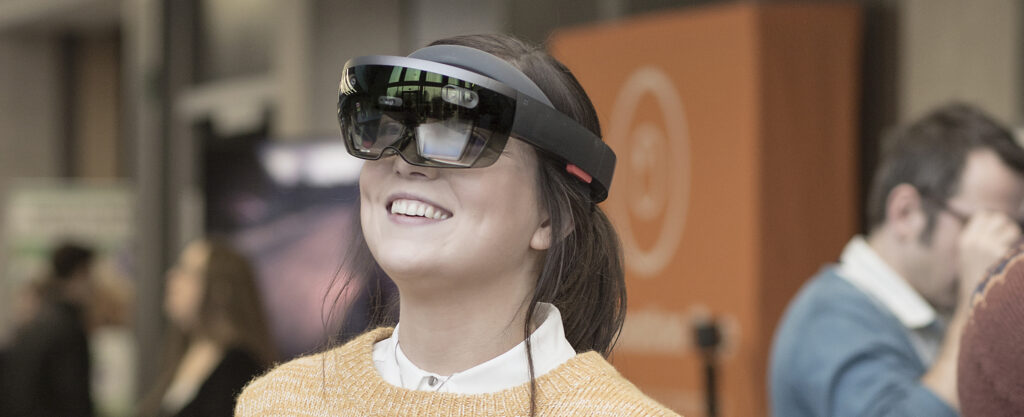
Mixed Reality (MR) was defined by Paul Milgram and Fumio Kishino in 1994 to describe environments where physical and digital objects do not just coexist, but actively interact in real time. Unlike basic graphic overlays, MR leverages spatial computing to map the physics of a room, allowing a virtual object to bounce off a real table or hide behind a physical wall. The technology gained massive visibility via hardware like the Microsoft HoloLens, and today it transforms industries by allowing remote engineers to collaborate on interactive 3D digital twins layered directly over physical machinery.
Extended Reality (XR) emerged in the late 2010s as a vital umbrella term encapsulating the entire spectrum of AR, VR, and MR (Moorhouse et al., 2021). Rather than a single technology, XR acts as industry shorthand for the broader shift towards spatial computing. The term has gained rapid traction as modern hardware increasingly blurs boundaries, allowing users to fluidly transition from simple AR overlays to total VR isolation on a single device. Today, XR is recognised as a foundational computing shift driving cross-disciplinary innovation across healthcare, education, and entertainment programmes.
The creative and digital economy continues to act as a significant growth engine for major global nations, with the structural evolution of Extended Reality (XR) driving the sector forward. According to official government statistics released by the Department for Culture, Media and Sport (DCMS), the UK’s creative industries contribute a massive £145.8 billion in Gross Value Added (GVA) to the national economy, outpacing the wider UK economic growth rate by more than four to one.
A primary catalyst within this modern landscape is the rapid growth of immersive technology. Data compiled by techUK highlights that the UK’s XR market is projected to reach £11.5 billion by 2030, propelled by an extraordinary compound annual growth rate of 28.5%. Far surpassing its early reputation as a gaming gimmick, the commercial integration of XR across diverse sectors has the potential to add an estimated £62.5 billion in gross value to the wider UK economy.
This immense financial footprint is fundamentally reshaping the workforce within the creative and industrial sectors. Driven by the convergence of spatial computing, artificial intelligence, and lightweight wearable hardware, immersive media development, real-time simulation engineering, and interactive software design are solving critical skills shortages. Across the UK creative sector, this economic and technological integration is shifting the paradigm entirely from basic digital overlays towards the generation of highly impactful, cross-disciplinary innovations that redefine how the nation builds, trains, and creates.
Innovation, business growth and access to talent
We work with public and private organisations of all sizes, from SMEs to multinationals to address real-world problems and develop industry-leading solutions. Whether you’re looking to create new products or services, solve a problem, train your staff or hire our highly-skilled graduates, working with Manchester Met could help you grow or improve your business.
Manchester Metropolitan University is the largest campus-based undergraduate university in the UK with a total student population of more than 37,000. It is a University for World Class professionals with an emphasis on vocational education and employability.
We can work with you to conduct specialist research, share our ultramodern facilities or simply provide business consultation and advice.